
Tiempo malgastado. Sobre el aplazamiento de la escritura en tres novelas hispanoamericanas
| dc.contributor.author | Rodríguez, Amán Rosales | |
| dc.contributor.editor | Koźluk, Magdalena | |
| dc.contributor.editor | Staroń, Anita | |
| dc.date.accessioned | 2022-08-26T08:03:55Z | |
| dc.date.available | 2022-08-26T08:03:55Z | |
| dc.date.issued | 2022 | |
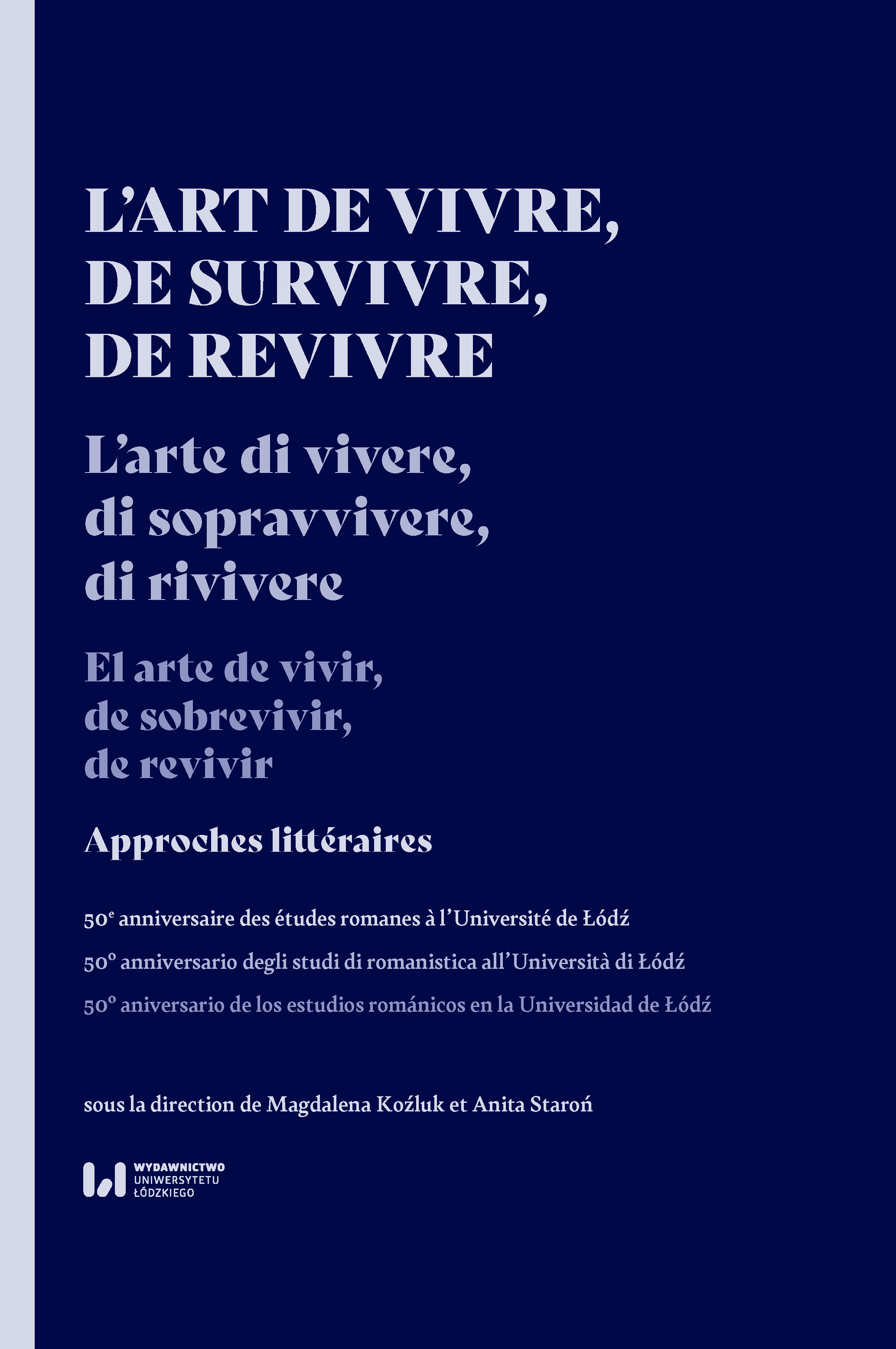
| dc.identifier.citation | Rodríguez A.R., Tiempo malgastado. Sobre el aplazamiento de la escritura en tres novelas hispanoamericanas, [w:] L’art de vivre, de survivre, de revivre. Approches littéraires. Le 50e anniversaire des études romanes à l’Université de Łódź, Koźluk M., Staroń A. (red.), Wydawnictwo Uniwersytetu Łódzkiego, Łódź 2022, s. 337-349, https://doi.org/10.18778/8220-877-1.25 | pl_PL |
| dc.identifier.isbn | 978-83-8220-877-1 | |
| dc.identifier.uri | http://hdl.handle.net/11089/42991 | |
| dc.description.abstract | In the last decades, many studies have proliferated on the different ways in which a specific modality of consumer society, characterized by an unbridled acceleration of the rhythms of production and work, affects the lives of millions of people, especially in highly industrialized nations. These studies suggest that the individuals, under the pressure of an increasingly accelerated and frenetic pace of life, are compelled to perform certain roles and achieve certain goals that, if satisfactorily fulfilled, could guarantee success, or, at least, social acceptance. But what happens when you cannot or do not want to perform and fulfil such roles and expectations “fast” enough, when the individual prolongs or just abandons the entrusted task? In the richly diverse world of Latin American fiction, many writers have tackled this question. In base of three novels of different years: “El libro vacío” (1958), by the Mexican Josefina Vicens, “Wasabi” (1994), by the Argentine Alan Pauls, and “La novela luminosa” (2005), by the Uruguayan Mario Levrero, this paper comments the role played in contemporary fiction by the figure of the apathic, indolent or just slow-moving writer. The main characters of those novels seem to live in a slow-time dimension opposed to the fast one dominant in late modernity. | pl_PL |
| dc.language.iso | es | pl_PL |
| dc.publisher | Wydawnictwo Uniwersytetu Łódzkiego | pl_PL |
| dc.relation.ispartof | Koźluk M., Staroń A. (red.), L’art de vivre, de survivre, de revivre. Approches littéraires. Le 50e anniversaire des études romanes à l’Université de Łódź, Wydawnictwo Uniwersytetu Łódzkiego, Łódź 2022; | |
| dc.rights | Attribution-NonCommercial-NoDerivatives 4.0 Międzynarodowe | * |
| dc.rights.uri | http://creativecommons.org/licenses/by-nc-nd/4.0/ | * |
| dc.subject | Latin American narrative | pl_PL |
| dc.subject | late modernity | pl_PL |
| dc.subject | autofiction | pl_PL |
| dc.subject | sociology of time | pl_PL |
| dc.subject | cultural criticism | pl_PL |
| dc.title | Tiempo malgastado. Sobre el aplazamiento de la escritura en tres novelas hispanoamericanas | pl_PL |
| dc.title.alternative | Wasted Time. On the Postponement of Writing in Three Latin American Novels | pl_PL |
| dc.type | Book chapter | pl_PL |
| dc.rights.holder | © Copyright by Authors, Łódź 2022; © Copyright for this edition by University of Łódź, Łódź 2022 | pl_PL |
| dc.page.number | 337-349 | pl_PL |
| dc.contributor.authorAffiliation | Uniwersytet im. Adama Mickiewicza w Poznaniu | pl_PL |
| dc.identifier.eisbn | 978-83-8220-878-8 | |
| dc.contributor.authorBiographicalnote | Amán Rosales Rodríguez (dr hab.) es docente-investigador en la Universidad Adam Mickiewicz de Poznań (Departamento de Estudios Hispánicos) y en la Universidad de Łódź (Cátedra de Filología Española). Campo general de trabajo docente: literatura y pensamiento de América Latina. Su labor investigativa se concentra sobre todo en la ensayística y crítica cultural contemporánea. Se interesa por problemas de filosofía y sociología de la cultura, así como de antropología cultural en relación con la teoría y creación literaria. Ha publicado sus artículos en revistas especializadas polacas y del extranjero. | pl_PL |
| dc.references | Bauman, Zygmunt, et al., Arte, ¿líquido? Edición y trad. de Francisco Ochoa de Michelena, Madrid, Sequitur, 2007 | pl_PL |
| dc.references | Ehrenberg, Alain, La fatiga de ser uno mismo. Depresión y sociedad, trad. Rogelio C. Paredes, Buenos Aires, Ediciones Nueva Visión, 2000 | pl_PL |
| dc.references | Fuest, Leonhard, Poetik des Nicht(s)tuns. Verweigerunstrategien in de Literatur seit 1800, München, Fink, 2008 | pl_PL |
| dc.references | García, Mariano, «Las dos caras de la autoficción en La novela luminosa de Mario Levrero», Pasavento. Revista de Estudios Hispánicos, III (1), 2015, p. 137-153, URL https://ebuah.uah.es/dspace/handle/10017/23500 fecha de consulta 3.07.2021 | pl_PL |
| dc.references | Gergen, Kenneth J. El yo saturado. Dilemas de identidad en el mundo contemporáneo, trad. Leandro Wolfson, Barcelona, Paidós, 2006 | pl_PL |
| dc.references | Gutiérrez, Adriana, «Dualidad de la escritura y en la escritura: El libro vacío, de Josefina Vicens », Mester, 20 (2), 1991, p. 49-66, URL https://escholarship.org/uc/item/16d428xc fecha de consulta 3.07. 2021 | pl_PL |
| dc.references | Inzaurralde, Gabriel, «Apuntes sobre La novela luminosa de Mario Levrero», Revista Iberoamericana, LXXVIII, (241), 2012, p. 1043-1065, URL http://revista-iberoamericana.pitt.edu/ojs/index.php/Iberoamericana/article/view/6988/7142 fecha de consulta 3.07.2021 | pl_PL |
| dc.references | Laera, Alejandra, «Monstruosa compensación. Peripecias de un escritor contemporáneo en Wasabi de Alan Pauls», Revista Iberoamericana, LXXV (227), 2009, p. 459-474, URL https://revista-iberoamericana.pitt.edu/ojs/index.php/Iberoamericana/article/view-File/6584/6760 fecha de consulta 3.7.2021 | pl_PL |
| dc.references | Levrero, Mario, La novela luminosa, Barcelona, Debolsillo, 2008 | pl_PL |
| dc.references | López González, Aralia, «Subjetividad, literatura y alienación en El libro vacío de Josefina Vicens», Literatura Mexicana, 4 (1), 1993, p. 87-101, URL https://revistas-filologicas.unam.mx/literatura-mexicana/index.php/lm/article/view/845 fecha de consulta 3.07.2021 | pl_PL |
| dc.references | Pauls, Alan, Wasabi, Buenos Aires, Anagrama, 2012 | pl_PL |
| dc.references | Rosa, Hartmut, Alienación y aceleración. Hacia una teoría crítica de la temporalidad en la modernidad tardía, trad. CEIICH, Buenos Aires, Katz Editores, 2016 | pl_PL |
| dc.references | Vanden Berghe, Kristine, «Wasabi, de Alan Pauls: una lectura alegórica en clave autoficcional », Pasavento, III (1), 2015, p. 29-42, URL https://ebuah.uah.es/dspace/bitstream/handle/10017/23479/wasabi_vanden_PASAVENTO_2015_V3_N1.pdf?sequence=1&isAllowed=y fecha de consulta 3.07.2021 | pl_PL |
| dc.references | Vicens, Josefina, El libro vacío. Los años falsos, México, FCE, 2011, URL https://mochig57.files.wordpress.com/2015/11/el-libro-vacc3ado-los-ac3b1os-falsos-josefina-vicens.pdf fecha de consulta 3.07.2021 | pl_PL |
| dc.references | Wajcman, Judy, Esclavos del tiempo. Vidas aceleradas en la era del capitalismo digital, trad. Francisco J. Ramos Mena, Barcelona, Paidós, 2017 | pl_PL |
| dc.contributor.authorEmail | arosales@amu.edu.pl | pl_PL |
| dc.identifier.doi | 10.18778/8220-877-1.25 | |
| dc.discipline | literaturoznawstwo | pl_PL |
Pliki tej pozycji
Pozycja umieszczona jest w następujących kolekcjach

Poza zaznaczonymi wyjątkami, licencja tej pozycji opisana jest jako Attribution-NonCommercial-NoDerivatives 4.0 Międzynarodowe