
Le trésor des priamèles bibliques du "Livre des Proverbes" – analyse sémantique
| dc.contributor.author | Lipińska, Magdalena | |
| dc.contributor.editor | Lipińska, Magdalena | |
| dc.contributor.editor | Szeflińska-Baran, Magdalena | |
| dc.date.accessioned | 2022-08-25T15:45:11Z | |
| dc.date.available | 2022-08-25T15:45:11Z | |
| dc.date.issued | 2022 | |
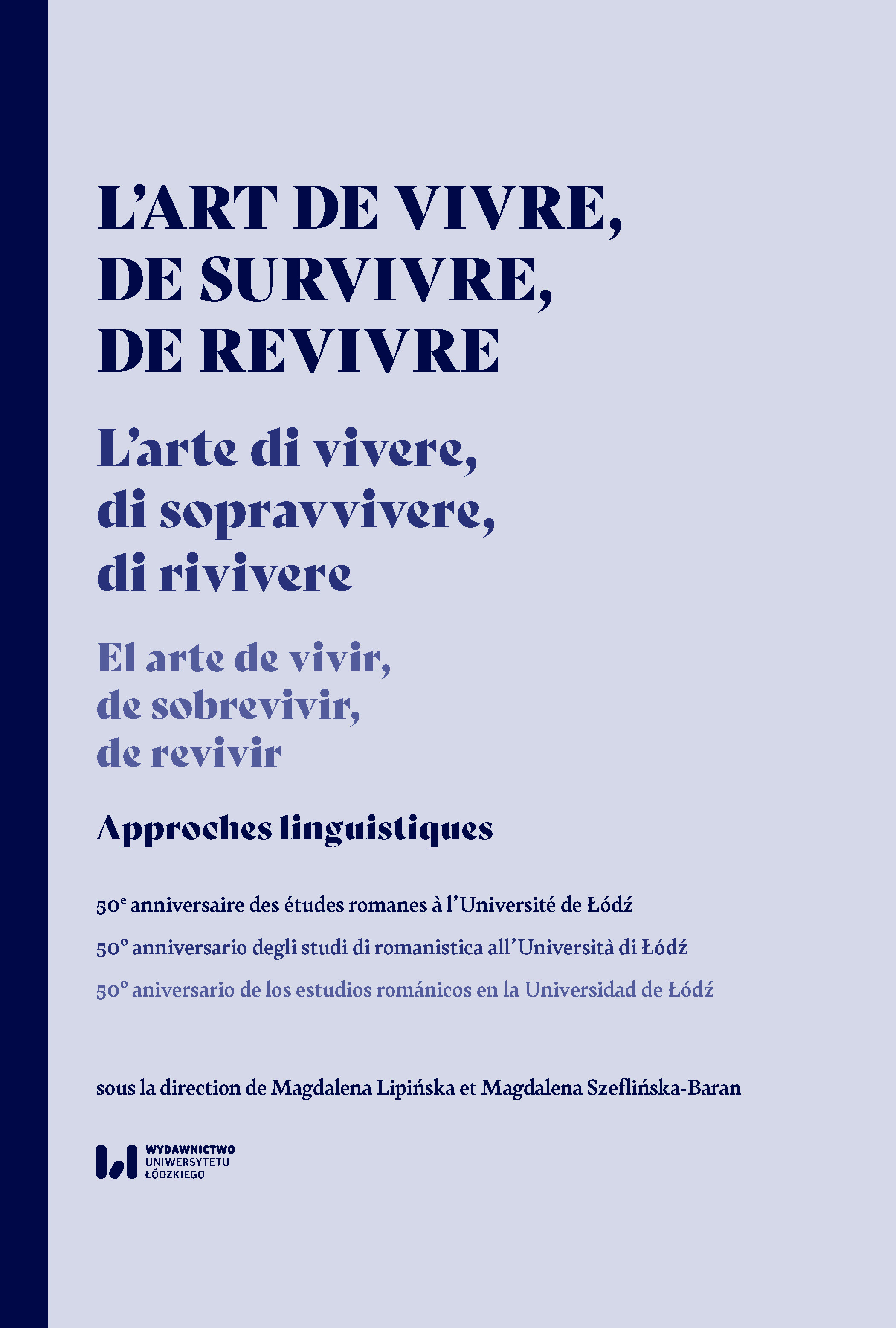
| dc.identifier.citation | Lipińska M., Le trésor des priamèles bibliques du "Livre des Proverbes" – analyse sémantique, [w:] L’art de vivre, de survivre, de revivre. Approches linguistiques. Le 50e anniversaire des études romanes à l’Université de Łódź, Lipińska M., Szeflińska-Baran M. (red.), Wydawnictwo Uniwersytetu Łódzkiego, Łódź 2022, s. 155-165, https://doi.org/10.18778/8220-879-5.13 | pl_PL |
| dc.identifier.isbn | 978-83-8220-879-5 | |
| dc.identifier.uri | http://hdl.handle.net/11089/42943 | |
| dc.description.abstract | „Novitas” is emphasized in biblical priamels from the „Book of Proverbs” both from the point of view of subject matter and their linguistic form. The validity of their subject matter stems from the fact that they belong to wisdom literature, which, according to the intentions of their authors, was supposed to the canon of conduct for the whole society. The researched proverbs depict the art of life being of potential interest to the recipient from the 21st century. Despite being marked by the realities from a different epoch, these sentences are still attractive content-wise. Next to individual references to the force majeure we find in priamels still valid comments on the human nature as well as timeless philosophy of life based on moderation, especially useful in the epoch of predominating consumerism. Explicit moral norms precisely define first and foremost types of behaviour and attitudes which we should avoid as well as those which are welcome. | pl_PL |
| dc.language.iso | fr | pl_PL |
| dc.publisher | Presses Universitaires de Łódź | pl_PL |
| dc.relation.ispartof | Lipińska M., Szeflińska-Baran M. (red.), L’art de vivre, de survivre, de revivre. Approches linguistiques. Le 50e anniversaire des études romanes à l’Université de Łódź, Wydawnictwo Uniwersytetu Łódzkiego, Łódź 2022; | |
| dc.rights | Attribution-NonCommercial-NoDerivatives 4.0 Międzynarodowe | * |
| dc.rights.uri | http://creativecommons.org/licenses/by-nc-nd/4.0/ | * |
| dc.subject | art of living | pl_PL |
| dc.subject | Book of Proverbs | pl_PL |
| dc.subject | priamel | pl_PL |
| dc.subject | proverb | pl_PL |
| dc.subject | semantic analysis | pl_PL |
| dc.title | Le trésor des priamèles bibliques du "Livre des Proverbes" – analyse sémantique | pl_PL |
| dc.title.alternative | The treasure of biblical priamels from the "Book of Proverbs" – a semantic analysis | pl_PL |
| dc.type | Book chapter | pl_PL |
| dc.rights.holder | © Copyright by Authors, Łódź 2022; © Copyright for this edition by Uniwersytet Łódzki, Łódź 2022 | pl_PL |
| dc.page.number | 155-165 | pl_PL |
| dc.contributor.authorAffiliation | Université de Łódź, Faculté de Philologie, Institut de Philologie Romane, Pomorska 171/173, 91-404 Łódź, Pologne. | pl_PL |
| dc.identifier.eisbn | 978-83-8220-880-1 | |
| dc.contributor.authorBiographicalnote | Magdalena Lipińska, docteur d’État-ès-Lettres est professeure à l’Université de Łódź où elle travaille à l’Institut d’Études Romanes. Elle est l’auteure des monographies (p. ex. „Essais sur les priamèles polonaises”, Wydawnictwo Uniwersytetu Łódzkiego, Łódź 2006; „L’équivalence des proverbes polonais et des proverbes français”, Wydawnictwo Uniwersytetu Łódzkiego, Łódź 2004 ; „Les proverbes prototypiques polonais et français”, Oficyna Wydawnicza Leksem, Łask 2003 ; „Le comique de phrases autonymiques polonaises et françaises. Analyse sémantique, stylistique et pragmatique” (2020)) et de nombreux articles dans les domaines de la parémiologie, la phraséologie, la sémantique et des études contrastives. Elle participe aux travaux de la Section Phraséologique de l’Académie Polonaise des Sciences. | pl_PL |
| dc.references | BERGMANN, F.-G. (1868). La priamèle dans les différentes littératures anciennes et modernes. Extrait de la Revue d’Alsace, Imprimerie et lithographie de Camille Decker, Colmar, Strasbourg. | pl_PL |
| dc.references | KS. BRZEGOWY, T., KS. COLACRAI, A. SSP, KS. ŁACH, J., KS. MICKIEWICZ, F. SAC, KS. TRONINA, A., KS. WARZECHA, J. SAC (réd.) (2013). Pismo Święte Starego i Nowego Testamentu, Edycja Świętego Pawła. | pl_PL |
| dc.references | GILBERT, M. (2003). Les cinq livres des Sages. Paris : Les Éditions du Cerf. | pl_PL |
| dc.references | KLEIBER, G. (1994). Sur la définition du proverbe. In Nominales, Paris : Armand Colin, pp. 207–224. | pl_PL |
| dc.references | KRĘCIDŁO, J. (2006). Portret mędrca w Księdze Przysłów, 1,1-7. Collectanea Theologica, 76/1, pp. 5-25. http://bazhum.muzhp.pl/media//files/Collectanea_Theologica/Collectanea_Theologica-r2006-t76-n1/Collectanea_Theologica-r2006-t76-n1-s5-25/Collectanea_Theologica-r2006-t76-n1-s5-25.pdf [27/10/2020]. | pl_PL |
| dc.references | KRĘCIDŁO, J. (2015). Kontekst społeczny i teologiczny Księgi Przysłów. | pl_PL |
| dc.references | Warszawskie Studia Teologiczne, XXXIII/x/2015, pp. 60-77. https://www.researchgate.net/publication/303312749_Kontekst_spoleczny_i_teologiczny_Ksiegi_Przyslow [27/10/2020]. | pl_PL |
| dc.references | LIPIŃSKA, M. (2004). L’équivalence des proverbes polonais et des proverbes français. Łódź : Wydawnictwo Uniwersytetu Łódzkiego. | pl_PL |
| dc.references | LIPIŃSKA, M. (2020). Le comique de phrases autonymiques polonaises et françaises. Analyse sémantique, stylistique et pragmatique. Łódź : Wydawnictwo Uniwersytetu Łódzkiego. | pl_PL |
| dc.references | https://www.tekstowo.pl/piosenka,joe_dassin,le_jardin_du_luxembourg.html [27/10/2020]. | pl_PL |
| dc.contributor.authorEmail | magdalena.lipinska@uni.lodz.pl | pl_PL |
| dc.identifier.doi | 10.18778/8220-879-5.13 | |
| dc.discipline | językoznawstwo | pl_PL |
Files in this item
This item appears in the following Collection(s)

Except where otherwise noted, this item's license is described as Attribution-NonCommercial-NoDerivatives 4.0 Międzynarodowe