
From Translation to Intersemiosis: A Journey across Expressive Modalities
| dc.contributor.author | Sanjinés, José | |
| dc.contributor.editor | Deckert, Mikołaj | |
| dc.contributor.editor | Kocot, Monika | |
| dc.contributor.editor | Majdzińska-Koczorowicz, Aleksandra | |
| dc.date.accessioned | 2021-10-25T11:39:51Z | |
| dc.date.available | 2021-10-25T11:39:51Z | |
| dc.date.issued | 2020 | |
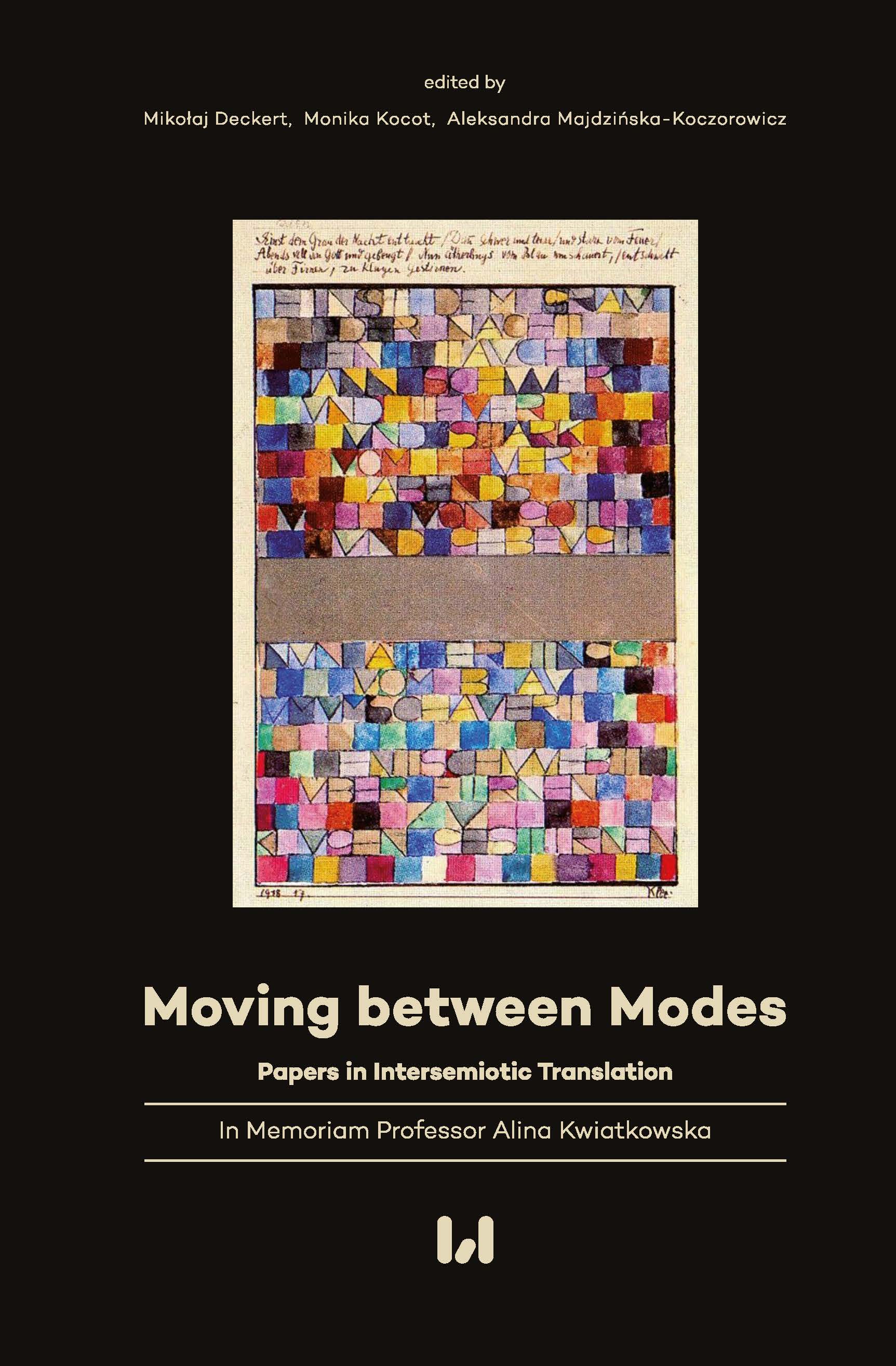
| dc.identifier.citation | Sanjinés J., From Translation to Intersemiosis: A Journey across Expressive Modalities, [in:] Moving between Modes. Papers in Intersemiotic Translation in Memoriam Professor Alina Kwiatkowska, Deckert M., Kocot M., Majdzińska-Koczorowicz A. (eds.), Łódź University Press, Łódź 2020, pp. 43-59, doi: 10.18778/8220-191-8.04 | pl_PL |
| dc.identifier.isbn | 978-83-8220-191-8 | |
| dc.identifier.uri | http://hdl.handle.net/11089/39534 | |
| dc.language.iso | en | pl_PL |
| dc.publisher | Łódź University Press | pl_PL |
| dc.relation.ispartof | Deckert M., Kocot M., Majdzińska-Koczorowicz A. (eds.), Moving between Modes. Papers in Intersemiotic Translation in Memoriam Professor Alina Kwiatkowska, Łódź University Press, Łódź 2020; | |
| dc.rights | Attribution-NonCommercial-NoDerivatives 4.0 Międzynarodowe | * |
| dc.rights.uri | http://creativecommons.org/licenses/by-nc-nd/4.0/ | * |
| dc.title | From Translation to Intersemiosis: A Journey across Expressive Modalities | pl_PL |
| dc.type | Book chapter | pl_PL |
| dc.page.number | 43-59 | pl_PL |
| dc.contributor.authorAffiliation | Coastal Carolina University | pl_PL |
| dc.identifier.eisbn | 978-83-8220-192-5 | |
| dc.contributor.authorBiographicalnote | José Sanjinés, Professor in the Department of Communication, Media, & Culture at Coastal Carolina University. His recent scholarship explores the possibilities (and limits) of today’s multimodal systems of communication. His work has been published in journals such as Semiotica, Signs and Society, Studies in Communication Science, Sign System Studies, Semiotics, The American Journal of Semiotics, Interdisciplinary Journal for Germanic Linguistics and Semiotic Analysis, The Latin Americanist, Inti, El Ojo que Piensa, Corresponding Voices, and Point of Contact. He is the author of poetry, fiction, and a book on the short narrative of Julio Cortázar: Paseos en el horizonte [Strolls in The Horizon]. | pl_PL |
| dc.references | Ayres, Marco (2020). Projecto Genoma Artístico [Genome Art Project]. http://marcoayres4.blogspot.com/2014/01/sobre-o-projecto.html [accessed Dec. 17, 2020]. | pl_PL |
| dc.references | Benjamin, Walter (1996). “The Task of the Translator”. In: Selected Writings. Eds. Marcus Bullock and Michael W. Jennings. Vol. I (1913–1926). Cambridge, Mass.: The Harvard University Press. | pl_PL |
| dc.references | Clüver, Claus (1989). “On Intersemiotic Transposition”. Poetics Today 10 (1) (Spring): 55–90. | pl_PL |
| dc.references | Dalí, Salvador (1987). “Preface”. In: Dialogues with Marcel Duchamp. Ed. Pierre Cabanne. (13–14). New York: Da Capo. | pl_PL |
| dc.references | Eco, Umberto (1977). “The Influence of Roman Jakobson in the Development of Semiotics”. In: Roman Jakobson: Echoes of His Scholarship. Eds. Daniel Armstrong and Cornelis Hendrik van Schooneveld. (39–58). Lisse: De Ridder. | pl_PL |
| dc.references | Eco, Umberto (2008). Experiences in Translation. Trans. Alastair McEwen. Toronto: University of Toronto Press. | pl_PL |
| dc.references | Eco, Umberto (2010). “Thirty Years Later: A New (and More Modest) Recognition of Semiotics”. Translation of “Trent’anni dopo: nuova (e più modesta) ricognizione della semiotica”. 31 gennaio 2010. Sapienza Università di Roma, Aula Magna. 4a lezione magistrale. CIEG: Cattedra Internazionale Emilio Garroni. 21 January 2010. https://www.cieg.info/umberto-eco-trentanni-dopo/ [accessed Dec. 17, 2020]. | pl_PL |
| dc.references | Garroni, Emilio (1977). Ricognizione della semiotica: Tre lezioni. Roma: Officina. | pl_PL |
| dc.references | González Vaquerizo, Helena (2014). “Navigare necesse est; vivere non est necesse. Del discurso historiográfico al fado”. Revista de Estudios Latinos (RELat) 14: 165–77. | pl_PL |
| dc.references | Jakobson, Roman (1971). “Language in Relation to Other Communication Systems”. Selected Writings II. (697–708). The Hague: Mouton. | pl_PL |
| dc.references | Jakobson, Roman (2009a). “On Linguistic Aspects of Translation”. Language in Literature. Eds. Krystyna Pomorska and Stephen Rudy. (428–435). Cambridge, Mass.: Harvard University Press. | pl_PL |
| dc.references | Jakobson, Roman (2009b). “Linguistics and Poetics”. Language in Literature. Eds. Krystyna Pomorska and Stephen Rudy. (62–94). Cambridge, Mass.: Harvard University Press. | pl_PL |
| dc.references | Johansen, Jørgen Dines (2002). Literary Discourse: A Semiotic-Pragmatic Approach to Literature. Toronto: University of Toronto Press. | pl_PL |
| dc.references | Lévi-Strauss, Claude (1978). Myth and Meaning. New York: Schocken. | pl_PL |
| dc.references | Lotman, Yuri (1976). Semiotics of Cinema. Trans. Mark E. Suino. Ann Arbor: Michigan Slavic Publications. | pl_PL |
| dc.references | Lotman, Yuri (1990). Universe of the Mind: A Semiotic Theory of Culture. Trans. Ann Shukman. Bloomington: Indiana University Press. | pl_PL |
| dc.references | Murakami, Haruki (1994). The Elephant Vanishes. New York: Vintage. | pl_PL |
| dc.references | Nabokov, Vladimir (1969). Ada or Ardor: A Family Chronicle. New York: McGraw-Hill. | pl_PL |
| dc.references | Nattiez, Jean-Jacques (1990). Music and Discourse: Toward a Semiology of Music. Princeton: Princeton University Press. | pl_PL |
| dc.references | Nöth, Winfried (1999). Handbook of Semiotics. Bloomington: Indiana University Press. | pl_PL |
| dc.references | Paz, Octavio (2011). Los signos en rotación. Madrid: Fórcola. | pl_PL |
| dc.references | Peirce and Victoria Lady Welby. Ed. Charles S. Hardwick. Bloomington: Indiana University Press. | pl_PL |
| dc.references | Peirce, Charles Sanders (1958). Collected Papers [CP]. Cambridge: Harvard University Press. | pl_PL |
| dc.references | Peirce, Charles Sanders (1977). Semiotic and Significs: The Correspondence between Charles S. Peirce and Victoria Lady Welby. Ed. Charles S. Hardwick. Bloomington: Indianapolis University Press. | pl_PL |
| dc.references | Peirce, Charles Sanders (1991). Peirce on Signs. Ed. James Hoopes. Chapel Hill: University of North Carolina Press. | pl_PL |
| dc.references | Pessoa, Fernando (2001). The Selected Prose of Fernando Pessoa. Ed. and trans. Richard Zenith. New York: Grove Press. | pl_PL |
| dc.references | Pessoa, Fernando (2007). Prosa Íntima e de Autoconhecimento. Ed. Richard Zenith. Lisbon: Assirio & Alvim. | pl_PL |
| dc.references | Rauch, Irmengard (2012). “The Power and Glory of Sound”. The American Journal of Semiotics 28 (1–2): 5–17. | pl_PL |
| dc.references | Saussure, Ferdinand de (1983). Course in General Linguistics. Eds. Charles Bally et al. La Salle, Ill.: Open Court. | pl_PL |
| dc.references | Torop, Peeter (2002). “Translation as Translating as Culture”. Sign Systems Studies 30 (3): 593–603. | pl_PL |
| dc.references | Veloso, Caetano. “Os Argonautas”. Lyrics. https://www.toptesti.com/text_os_argonautas_caetano_veloso_985474 [accessed Dec. 17, 2020]. | pl_PL |
| dc.references | Worth, Sol (1982). “Pictures Can’t Say Ain’t”. In: Film/Culture. Ed. Sari Thomas. (97–109). Metuchen, New Jersey: Scarecrow. | pl_PL |
| dc.references | Zenith, Richard (2017). “Nietzsche and the Super-Pessoa”. In: Pessoa in an International Web: Influence and Innovation. Ed. David G. Frier. New York: Routledge. | pl_PL |
| dc.identifier.doi | 10.18778/8220-191-8.04 |
Files in this item
This item appears in the following Collection(s)

Except where otherwise noted, this item's license is described as Attribution-NonCommercial-NoDerivatives 4.0 Międzynarodowe