
Sobre el origen de las fórmulas honoríficas con el sufijo -ísimo
| dc.contributor.author | Zieliński, Andrzej | |
| dc.contributor.editor | Grzelak-Krzymianowska, Adriana | |
| dc.contributor.editor | Woźniak, Maria Judyta | |
| dc.date.accessioned | 2020-03-12T11:41:58Z | |
| dc.date.available | 2020-03-12T11:41:58Z | |
| dc.date.issued | 2019 | |
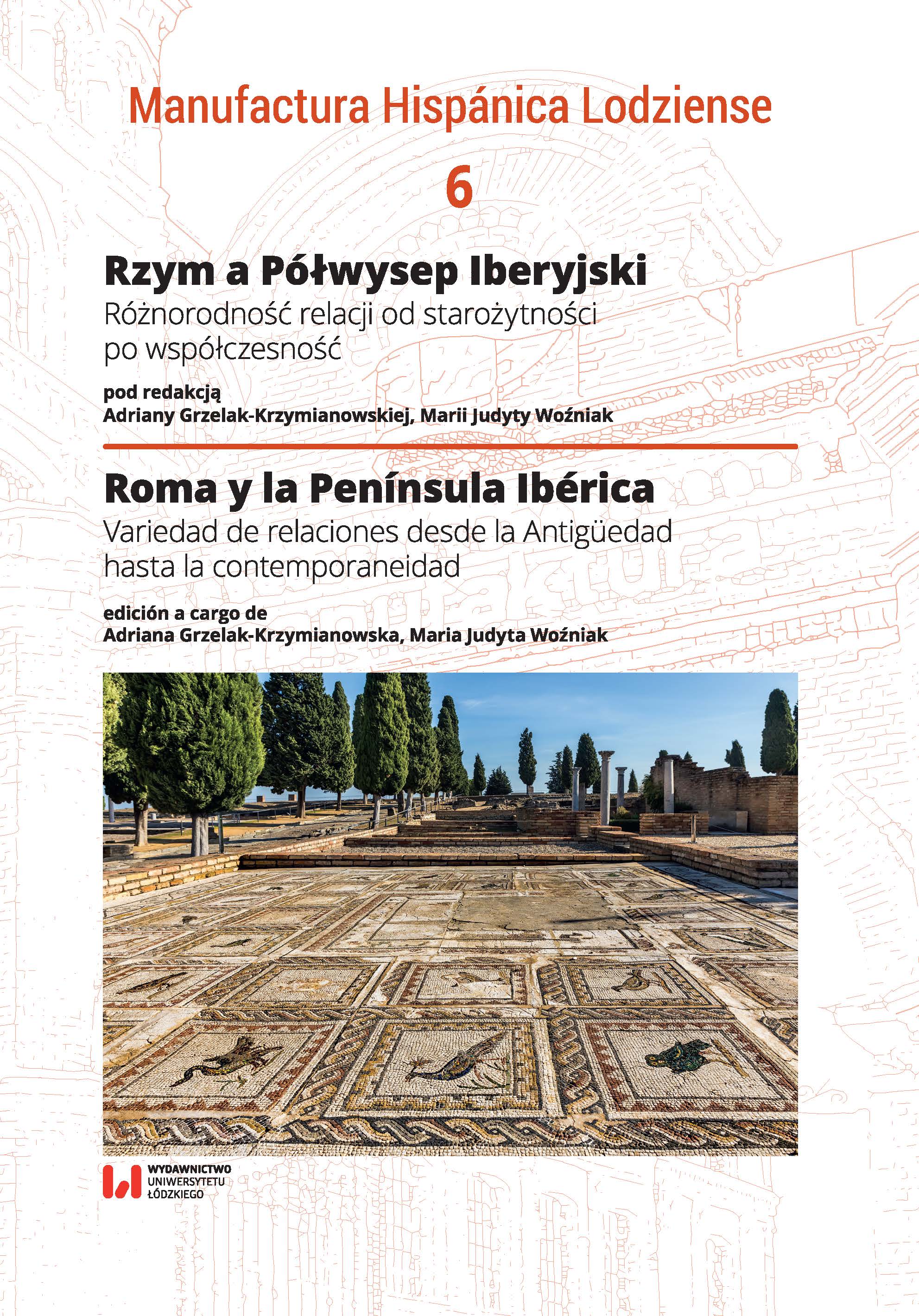
| dc.identifier.citation | Zieliński A., Sobre el origen de las fórmulas honoríficas con el sufijo -ísimo, w: A. Grzelak-Krzymianowska, M. J. Woźniak (red.), Rzym a Półwysep Iberyjski. Różnorodność relacji od starożytności po współczesność, „Manufactura Hispánica Lodziense 6”, WUŁ, Łódź 2019, http://dx.doi.org/10.18778/8142-506-3.05. | pl_PL |
| dc.identifier.isbn | 978-83-8142-506-3 | |
| dc.identifier.uri | http://hdl.handle.net/11089/31691 | |
| dc.description.abstract | The purpose of this paper is to explore and analyze diachronically honorific expressions with the superlative suffix -ísimo, whose origin corresponds to a pattern of lexicalization that reflects the interpersonal relations of the strongly stratified society of that time. In fact, the feudal pyramid, established since the fifth century AD, which places the highest classes at the highest point, is in clear correspondence with the conceptual metaphor “more is above”. Through analysis of a relatively large corpus of Latin (5th–12th centuries) and Spanish (13th–16th centuries) texts, I will try to find the main reasons that came to determine its use in the Castilian language. | pl_PL |
| dc.language.iso | es | pl_PL |
| dc.publisher | Wydawnictwo Uniwersytetu Łódzkiego | pl_PL |
| dc.relation.ispartof | Rzym a Półwysep Iberyjski. Różnorodność relacji od starożytności po współczesność. Manufactura Hispánica Lodziense 6; | |
| dc.rights | Attribution-NonCommercial-NoDerivatives 4.0 Międzynarodowe | * |
| dc.rights.uri | http://creativecommons.org/licenses/by-nc-nd/4.0/ | * |
| dc.subject | honorific expressions | pl_PL |
| dc.subject | superlative suffix | pl_PL |
| dc.subject | lexicalization pattern | pl_PL |
| dc.subject | feudalism | pl_PL |
| dc.title | Sobre el origen de las fórmulas honoríficas con el sufijo -ísimo | pl_PL |
| dc.type | Book chapter | pl_PL |
| dc.page.number | 57-72 | pl_PL |
| dc.contributor.authorAffiliation | Uniwersytet Jagielloński, Wydział Filologiczny, Instytut Filologii Romańskiej, Zakład Filologii Hiszpańskiej | pl_PL |
| dc.identifier.eisbn | 978-83-8142-507-0 | |
| dc.references | Bentivoglio, P. (2003): “Spanish forms of address in the sixteenth century”. En: I. Taavitsainen, A. H. Jucker (eds.), Diachronic Perspectives on Address Term Systems. Amsterdam/Philadelphia: John Benjamins Publishing, 177–191. | pl_PL |
| dc.references | Blank, A. (2001): “Pathways of lexicalization”. En: M. Haspelmath, E. König, W. Oesterreiche, W. Raible (eds.), Language Typology and Language Universals. Berlin/New York: De Gruyter, 1596–1608. | pl_PL |
| dc.references | Bourdieu, P. (1980), “Le Capital social”. Actes de la recherche en sciences sociales 31: 2–3. | pl_PL |
| dc.references | BREPOLIS: Brepolis Publishers (online), Library of Latin texts, http://www.brepolis.net/index.html [15.06.2017]. | pl_PL |
| dc.references | Brown, P., Levinson, S. C. (1987): Politeness: Some Universals in Language Usage. Cambridge/New York: Cambridge University Press. | pl_PL |
| dc.references | Camargo, M. (1991): Ars dictaminis – ars dictandi. Typologie des sources du Moyen Age occidental. Turnhout: Brepols. | pl_PL |
| dc.references | CORDE: Real Academia Española (online), Corpus diacrónico del español, http://www.rae.es [15.06.2017]. | pl_PL |
| dc.references | Daniel, M., Spencer, A. (2009): “The Vocative – An Outliner Case”. En: A. Malchukov, A. Spencer (eds.), The Oxford Handbook of Case. Oxford/New York: Oxford University Press, 626–634. | pl_PL |
| dc.references | Dickey, E. (2002): Latin Forms of Address: From Plautus to Apuleius. Oxford/New York: Oxford University Press. | pl_PL |
| dc.references | Díez Borque, J. M. (1990): La vida española en el Siglo de Oro según los extranjeros. Barcelona: Ediciones Serbal. | pl_PL |
| dc.references | Dihle, A. (1952): “Antike höflichkeit und christische Demut”. Studi italiani di filologia classica 26: 196–190. | pl_PL |
| dc.references | Engelbrecht, A. (1893): Das Titelwesen bei den spätlateinischen Epistolographen. Wien: Brzezowsky. | pl_PL |
| dc.references | Espinal, T. M. (2010): “On the stucture of vocatives”. En: B. Sonnenhauser, P. N. Azziz Hanna (eds.), Vocative! Addressing between system and performance. Berlin/New York: De Gruyter Mouton, 109–132. | pl_PL |
| dc.references | Goffman, E. (1967): Interaction Ritual: Essays in Face to Face Behavior. New York: Aldine Transaction. | pl_PL |
| dc.references | Herman, J. (1997), El latín vulgar. Barcelona: Ariel. | pl_PL |
| dc.references | Kabatek, J. (2006): “Tradiciones discursivas y cambio lingüístico”. En: G. Ciapuscio, K. Jungbluth, D. Kaiser, C. Lopes (eds.), Sincronía y diacronía de tradiciones discursivas en Latinoamérica. Frankfurt am Main/Madrid: Vervuert/Iberoamericana, 151–172. | pl_PL |
| dc.references | Koch, P. (2008): “Tradiciones discursivas y cambio lingüístico: el ejemplo del tratamiento ‘uestra merced’ en español”. En: J. Kabatek (ed.), Sintaxis histórica del español y cambio lingüístico: Nuevas perspectivas desde las Tradiciones Discursivas. Madrid/Frankfurt am Main: Iberoamericana/Vervuert, 53–88. | pl_PL |
| dc.references | Labov, W. (2001): Principles of Linguistic Change Social factors. Oxford: Blackwell. | pl_PL |
| dc.references | Lapesa, R. (1970): “Personas gramaticales y tratamientos en español”. Revista de la Universidad de Madrid XIX (74): 141–167. | pl_PL |
| dc.references | Leech, G. N. (1983): Principles of Pragmatics. London: Longman. | pl_PL |
| dc.references | Moreno, M. C. (2002): “The address system in the Spanish of the Golden Age”. Journal of Pragmatics 34: 15–47. | pl_PL |
| dc.references | NRLE: Alfonso XII (1805–1829): Novísima recopilación de las leyes de España: Dividida en XII. libros. En que se reforma la Recopilacion publicada por el Señor Don Felipe II en el año de 1567, reimpresa últimamente en el de 1775: Y se incorporan las pragmáticas, cédulas, decretos, órdenes y resoluciones Reales, y otras providencias no recopiladas y expedidas hasta el de 1804. (Con tres índices generales) / mandada formar por Carlos IV, Reproducción digital del original conservado en la Biblioteca de la Universidad de Sevilla, http://fama2.us.es/fde/ocr/2006/novisima.RecopilacionT1.pdf [15.06.2017]. | pl_PL |
| dc.references | O’Brien, M. B. (1930): Titles of Address in Christian Latin Epistolography to 543 A.D. Washington: Catholic University of America. | pl_PL |
| dc.references | Sánchez López, C. (2006): El grado de adjetivos y adverbios. Madrid: Arco/Libros. | pl_PL |
| dc.references | Sonnenhauser, B., Azziz Hanna, P. N. (2010): “Introduction: Vocative!”. En: B. Sonnenhauser, P. N. Azziz Hanna (eds.), Vocative! Addressing between system and performance. Berlin/New York: De Gruyter Mouton, I–XXV. | pl_PL |
| dc.references | Talmy, L (1985): “Lexicalization patterns: Semantic structure in lexical forms”. En: T. Shopen (ed.), Language typology and syntactic description. Grammatical Categories and the Lexicon, Vol. III. Cambridge: Cambridge University Press, 57–149. | pl_PL |
| dc.references | Terlingen, J. H. (1943): Los italianismos en español: desde la formación del idioma hasta principios del siglo XVII. Amsterdam: NV Noord-Hollandsche Uitgevers Maatschappij. | pl_PL |
| dc.references | Väänänen, V. (1985): Introducción al latín vulgar. Madrid: Gredos. | pl_PL |
| dc.references | Vossler, K. (1953): Einführung ins Vulgärlatein. München: Hueber. | pl_PL |
| dc.references | Wölfflin, E. (1879): Lateinische und Romanische Comparation. Erlangen: Verlag von Andreas Deichert. | pl_PL |
| dc.references | Zieliński, A. (2015a): “‘Hallé un río grandísimo, digo muy grande’: historia y comportamiento del sufijo -ísimo en español”. En: J. M. García Martín, T. Bastardín Candón, M. Rivas Zancarrón (eds.), Actas del IX Congreso Internacional de Historia de la Lengua Española (Cádiz, 2012). Madrid/Frankfurt am Main: Iberoamericana/Vervuert, 1157–1170. | pl_PL |
| dc.references | Zieliński, A. (2015b): “Sobre el proceso de lexicalización de las fórmulas honoríficas con el sufijo -ís(s)imo en español”. Anuari de Filologia. Estudis de Lingüística 4: 1–18. | pl_PL |
| dc.references | Zieliński, A. (2016): “‘A la illvstrissima y excelentissima Señora’: algunas observaciones sobre los títulos honoríficos con -ís(s)imo en el español áureo”. En: J. Wilk-Racięska, A. Szyndler, C. Tatoj (eds.), Relecturas y nuevos horizontes de los estudios hispánicos: lingüística y didáctica de la Lengua Española. Katowice: Wydawnictwo Uniwersytetu Śląskiego, 218–230. | pl_PL |
| dc.references | Zieliński, A. (2017): Las fórmulas honoríficas con -ísimo. Contribución a la lexicalización de la deixis social. Frankfurt am Main: Peter Lang. | pl_PL |
| dc.identifier.doi | 10.18778/8142-506-3.05 |
Pliki tej pozycji
Pozycja umieszczona jest w następujących kolekcjach

Poza zaznaczonymi wyjątkami, licencja tej pozycji opisana jest jako Attribution-NonCommercial-NoDerivatives 4.0 Międzynarodowe