
El carácter sintético de la lengua latina y su legado cultural
| dc.contributor.author | Jiménez Juliá, Tomás | |
| dc.contributor.editor | Grzelak-Krzymianowska, Adriana | |
| dc.contributor.editor | Woźniak, Maria Judyta | |
| dc.date.accessioned | 2020-03-12T11:40:29Z | |
| dc.date.available | 2020-03-12T11:40:29Z | |
| dc.date.issued | 2019 | |
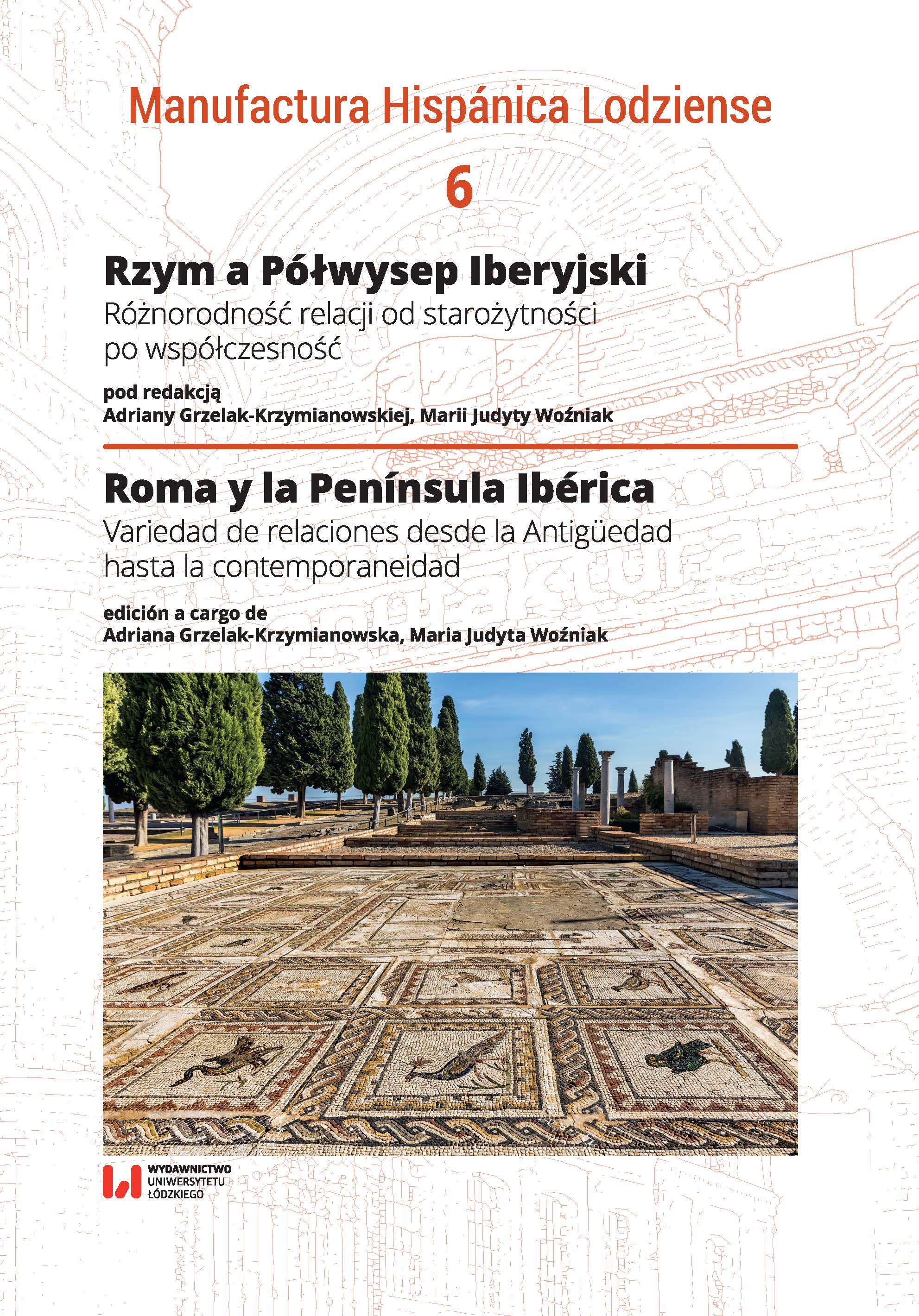
| dc.identifier.citation | Jiménez Juliá T., El carácter sintético de la lengua latina y su legado cultural, w: A. Grzelak-Krzymianowska, M. J. Woźniak (red.), Rzym a Półwysep Iberyjski. Różnorodność relacji od starożytności po współczesność, „Manufactura Hispánica Lodziense 6”, WUŁ, Łódź 2019, http://dx.doi.org/10.18778/8142-506-3.04. | pl_PL |
| dc.identifier.isbn | 978-83-8142-506-3 | |
| dc.identifier.uri | http://hdl.handle.net/11089/31690 | |
| dc.description.abstract | This paper deals with the possibility of establishing some kind of relationship between those languages which tend towards synthetic syntactic structures (not morphological) and speech communities with social and civil priorities which are equally synthetic and practical, and those languages with a more analytic syntax and communities with more ‘analytic’ civil and cultural priorities. The Roman world and Latin, as well as the British Empire and Modern English, seem to fit in the first frame, whereas Romance languages and European medieval societies, namely Spanish, could illustrate the second. | pl_PL |
| dc.language.iso | es | pl_PL |
| dc.publisher | Wydawnictwo Uniwersytetu Łódzkiego | pl_PL |
| dc.relation.ispartof | Rzym a Półwysep Iberyjski. Różnorodność relacji od starożytności po współczesność. Manufactura Hispánica Lodziense 6; | |
| dc.rights | Attribution-NonCommercial-NoDerivatives 4.0 Międzynarodowe | * |
| dc.rights.uri | http://creativecommons.org/licenses/by-nc-nd/4.0/ | * |
| dc.subject | typology | pl_PL |
| dc.subject | social idiosyncrasy | pl_PL |
| dc.subject | cultural legacies | pl_PL |
| dc.subject | synthetic syntax | pl_PL |
| dc.subject | analytic syntax | pl_PL |
| dc.title | El carácter sintético de la lengua latina y su legado cultural | pl_PL |
| dc.type | Book chapter | pl_PL |
| dc.page.number | 25-56 | pl_PL |
| dc.contributor.authorAffiliation | Universidad de Santiago de Compostela, Facultad de Filología, Departamento de lengua y Literatura espańolas | pl_PL |
| dc.identifier.eisbn | 978-83-8142-507-0 | |
| dc.references | Arnold, J. E., Losongco, A., Wasow, T., Ginstrom, R. (2000): “Heaviness vs. newness: The effects of structural complexity and discourse status on constituent ordering”. Language 76 (1): 28–55. | pl_PL |
| dc.references | Bock, J. K. (1982): “Toward a cognitive psychology of syntax: Information processing contributions to sentence formulation”. Psychological Review 89 (1): 1–47. | pl_PL |
| dc.references | Bock, J. K., Warren, R. K. (1985): “Conceptual accessibility and syntactic structure in sentence formulation”. Cognition 21 (1): 47–67. | pl_PL |
| dc.references | Bussmann, H. (1996): Routledge Dictionary of Language and Linguistics. Translated and edited by Gregory Trauth and Kerstin Kazzazi, London/New York: Routledge. | pl_PL |
| dc.references | Conze, E. (1978): El budismo. Su esencia y su desarrollo. México: Fondo de Cultura Económica. | pl_PL |
| dc.references | De la Peña Olivas, J. M. (2010): “Sistemas romanos de abastecimiento de aguas”. En: Las técnicas y las construcciones en la ingeniería romana. Córdoba (Congreso de las obras públicas romanas), 249–282. | pl_PL |
| dc.references | Dionisio de Halicarnaso (1984): Historia antigua de Roma. Traducción española y notas de E. Jiménez y E. Sánchez. Madrid: Gredos. | pl_PL |
| dc.references | Dixon, R. M. W. (1994): Ergativity. Australian languages: their nature and development. Cambridge: Cambridge University Press. (Cambridge Studies in Linguistics, 69). | pl_PL |
| dc.references | Eslava Galán, J. (1995): Historia de España contada para escépticos. Barcelona: Planeta. | pl_PL |
| dc.references | Greenberg, J. H. (1960): “A Quantitative Approach to the Morphological Typology of Language”. International Journal of American Linguistics 26: 178–194. | pl_PL |
| dc.references | Greenberg, J. H. (1963): “Some Universals of Grammar with Particular Reference to the Order of Meaningful Elements”. En: J. H. Greenberg, (ed.). Universals of Language. London: MIT Press, 73–113. | pl_PL |
| dc.references | Hawkins, J. A. (2004): Efficiency and complexity in grammars. Oxford: Oxford University Press. | pl_PL |
| dc.references | Her, W. I. (2002): La formación de palabras en chino y en español (tesis doctoral). Madrid: Universidad Complutense. | pl_PL |
| dc.references | Jiménez Juliá, T. (2017a): “Rasgos del español como lengua analítica”. Studia Romanistica 17 (1): 99–116. | pl_PL |
| dc.references | Jiménez Juliá, T. (2017b). “Notas sobre lenguas analíticas y sintéticas desde una óptica sintáctica”. En: J. L. Aliaga (ed.), En el centenario del Cours (1916) de Saussure. Pervivencia de la obra y nuevos retos de la lingüística. Zaragoza: Institución Fernando el Católico (en prensa). | pl_PL |
| dc.references | Jiménez Juliá, T., Doval Reixa I. (2014). “Notes on Germanic direct constructions. A contrastive approach with Spanish”. En: I. de la Cruz Cabanillas, C. Tejedor Martínez (eds.), Linguistic Insights. Studies on Languages. Alcalá de Henares: Universidad de Alcalá, 323–335. | pl_PL |
| dc.references | Lévi-Strauss, C. (1958): Anthropologie structurale. Paris: Plon. | pl_PL |
| dc.references | Litaudon, J. C. (2002): “Acqua Lugduniensis. El acueducto romano del Gier”. Traducción de I. Moreno Gallo, http://traiavans.net/ [15.08.2017]. | pl_PL |
| dc.references | Malinowski, B. (1923): “The Problem of Meaning in Primitive Languages”. Supplement I de C. K.. Ogden, I. A. Richards, The Meaning of Meaning. London: Kegan Paul, 296–336. | pl_PL |
| dc.references | MacDonald, M. C. (2013): “How language production shapes language from and comprehension”. Frontiers in Psychology 4: 1–16. | pl_PL |
| dc.references | Mendívil Giró, J. L. (2003): “Construcciones resultativas y gramática universal”. Revista Española de Lingüística 33 (1): 1–28. | pl_PL |
| dc.references | Moreno Cabrera, J. C. (2003): “Síntesis y análisis en las lenguas. Crítica de la tipología morfológica clásica y de algunas de sus aplicaciones sincrónicas y diacrónicas”. ELUA 17: 465–504. | pl_PL |
| dc.references | Nebrija, A. (1492): Gramática castellana. Madrid: Edición Junta del Centenario (2 vol.), 1946. | pl_PL |
| dc.references | Pabón, J.M. (1967): Diccionario manual Griego-Español Vox. Barcelona: Bibliograf. | pl_PL |
| dc.references | Radcliffe-Brown, A. R. (1952): Structure and function in primitive society. London: Cohen and West. | pl_PL |
| dc.references | Real Academia Española (1726): Diccionario de autoridades. Edición Facsímil. Madrid: Gredos, 1963. | pl_PL |
| dc.references | Roca Barea, M. E. (2016): Imperiofobia y leyenda negra. Madrid: Siruela. | pl_PL |
| dc.references | Ros, I. (2015): “Aiming at shorter dependencies: the role of agreement in morphology, Language, Cognition and Neuroscience 30. Issue 9: Laboratory in the field: Advances in cross-linguistic psycholinguistics, http://dx.doi.org/10.1080/23273798.2014.994009 [15.08.2017]. | pl_PL |
| dc.references | Schlegel, A. (1818): Observations sur la langue et la littérature provençales. Paris: Librairie grecque-latine-allemande. | pl_PL |
| dc.references | Siegel, J., Szmrecsanji, B., Kortmann, B. (2014): “Measuring analyticity and syntheticity in creoles”. Journal of Pidgin and Creole Languages 29 (1): 49–85. | pl_PL |
| dc.references | Sorbet, P. (2017). “Los mecanismos de creación léxica en español y en polaco”. Studia Romanistica 17 (1): 129–140. | pl_PL |
| dc.references | Sousa Pereira, S. de (2007): Estudio contrastivo del régimen verbal en el portugués de Brasil y el español peninsular. Tesis Doctoral inédita. Universidad de Santiago de Compostela. | pl_PL |
| dc.references | Trask, R. L. (1993): A dictionary of grammatical terms in linguistics. London/New York: Routledge. | pl_PL |
| dc.references | Torres i Graell, A. (1983): Kanji. La escritura japonesa. Madrid: Hiperión. | pl_PL |
| dc.references | Villacañas, J. L. (2019): Imperiofilia y el populismo nacional-católico, Madrid: Lengua de Trapo. | pl_PL |
| dc.references | Wasow, T. (1997): “Remarks on grammatical weight”. Language Variation and Change 9 (1): 81–105. | pl_PL |
| dc.references | Whorf, B. L. (1956): Language, Thought, and Reality. Selected writings of Benjamin Lee Whorf, Cambridge, Mass.: Technology Press of Massachusetts Institute of Technology. | pl_PL |
| dc.references | Yamashita, H., Chang, F. (2001): “Long before short preference in the production of a head-final language”. Cognition 81 (2): B45–B55. | pl_PL |
| dc.identifier.doi | 10.18778/8142-506-3.04 |
Files in this item
This item appears in the following Collection(s)

Except where otherwise noted, this item's license is described as Attribution-NonCommercial-NoDerivatives 4.0 Międzynarodowe